FG NOT DEVELOPING LAGOS SEAPORTS AT THE EXPENSE OF EASTERN SEAPORTS; OYETOLA SAYS AT LEAGUE OF MARITIME EDITORS’ AGM
Spread the love
NIMASA CORPORATE STRIPNCC CORPORATE STRIP
FG NOT DEVELOPING LAGOS SEAPORTS AT THE EXPENSE OF EASTERN SEAPORTS; OYETOLA SAYS AT LEAGUE OF MARITIME EDITORS’ AGM
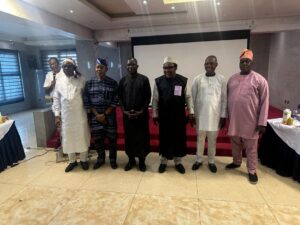
Minister of Marine and Blue Economy, Dr. Adegboyega Oyetola, CON.Out-going president of the League of Maritime Editors, Mrs Remi Itie (first right), ACG Charles Edike & Chairman of the occasion, Captain Ebubeogu
Minister of Marine and Blue Economy, Chief Adegboyega Oyetola, CON, has said that the Federal government is not developing the Lagos seaports at the expense of the Eastern seaports.
At the Annual General Meeting of the League of Maritime Editors in Lagos today, the minister, represented by the Director of Press at the ministry, Mrs Anastasia, stated that government is strengthening Lagos ports, while building the capacity of the Eastern corridor to assume a greater and more strategic share of national maritime traffic.
Distinguished ladies and gentlemen, we must also recognise that redistributing cargo and vessel calls will not happen simply because infrastructure is improved. Shipping lines make commercial decisions. They consider draft, berth availability, cargo volumes, turnaround time, security, reliability, tariffs, hinterland connectivity and, importantly, the overall predictability of port operations. For this reason, the Ministry is pursuing a broader package of complementary reforms.
First, maritime security and navigational safety: We will continue to support measures that enhance security along the Eastern maritime corridor and build confidence among shipowners, operators and cargo interests.
Second, operational and commercial incentives
We must create conditions that make it commercially attractive for shipping lines and cargo owners to use ports outside Lagos.
This will require continuous engagement with terminal operators, shipping lines, freight forwarders, cargo owners and other stakeholders to identify and remove operational barriers.
Third, digitalisation
The digital transformation of port processes remains central to our reform agenda.
The National Single Window, Port Community System and related digital initiatives are intended to reduce unnecessary physical interactions, improve information sharing among agencies and operators, enhance transparency and make cargo clearance more predictable.
A cargo owner should be able to determine the most efficient gateway on the basis of transparent and reliable information, rather than simply following historical patterns.
Fourth, stronger hinterland connectivity
A port is only as competitive as the logistics network that connects it to its market.
Consequently, greater attention must be given to road, rail, inland waterway and barge connectivity.
The development of efficient multimodal connections to the Eastern ports will be particularly important in unlocking their potential and extending their market reach beyond their immediate geographical locations.
Fifth, stronger public-private partnership
Government will continue to create an enabling environment for private investment in port infrastructure, terminal operations, logistics and related services.
Representative of minister of Marine & Blue, Mrs Anastasia (3rd from left)
The investments already taking place in and around ports such as Onne and Port Harcourt demonstrate that private capital is willing to participate where there is a credible commercial opportunity and a supportive regulatory environment.
Our responsibility as Government is to provide the policy certainty, infrastructure, security and regulatory environment that will enable such investments to flourish.
Let me also emphasise the important role of the maritime media in this transformation. The media is not merely a reporter of what happens in the sector. You are an important stakeholder in shaping public understanding, attracting investment and promoting accountability. As maritime editors and journalists, you have the capacity to interrogate policies, highlight bottlenecks, draw attention to areas requiring urgent intervention and, where progress is being made, communicate that progress to the public. I therefore encourage the League of Maritime Editors to continue providing a platform for objective and evidence-based discussion of the challenges confronting the sector.
Government must be prepared to listen to constructive criticism, just as the media must be prepared to recognise and communicate progress where progress is being made. That partnership is essential if we are to build a maritime sector that Nigerians can be proud of.
Distinguished ladies and gentlemen, the imbalance between Lagos and the Eastern ports is the product of decades of infrastructure, investment, operational and historical factors. It cannot be corrected overnight. But it can be corrected – and it must be corrected.
Our approach is therefore one of deliberate policy, strategic sequencing, infrastructure investment, private-sector participation, digital transformation, improved security and stronger multimodal connectivity. In this regard, the modernisation of the Eastern ports is not being conceived as an isolated regional intervention. It is part of a broader national strategy to develop a resilient, competitive and interconnected port system.
The commencement and prioritisation of interventions at the Western ports should therefore not be interpreted as a choice between Lagos and the East. It is about building a stronger Nigerian maritime system, one in which Lagos continues to serve as a major maritime gateway, while Onne, Port Harcourt, Warri, Calabar and other viable ports are developed to handle a greater and more diversified share of national and regional trade.
Our vision is a Nigeria where cargo moves through the gateway that provides the greatest efficiency, reliability and value, irrespective of its geographical location. That is the port system we are working to build. And when we achieve it, the benefits will go far beyond the ports themselves. We will reduce logistics costs, strengthen regional economies, attract investment, create jobs, improve trade competitiveness and reinforce Nigeria’s position as a leading maritime and logistics hub in West Africa.
Let me, at the outset, commend the League for its pioneering contribution to maritime journalism and for its sustained efforts to promote informed public discussion on developments in Nigeria’s maritime and blue economy sectors. Through your reporting, advocacy, constructive criticism and professional engagement, you have continued to provide an important platform for accountability, policy discussion and better understanding of the issues affecting our maritime industry.
The theme of this year’s conference, “Lagos/Eastern Ports: How to Reverse Existing Imbalance in Disproportionate Cargo Vessel Calls,” is particularly timely. It speaks directly to one of the longstanding challenges facing our maritime sector: the heavy concentration of vessel calls and cargo traffic at the Lagos ports, while the Eastern ports remain relatively underutilised.
This imbalance affects much more than the ports themselves. It has implications for national logistics costs, regional economic development, efficient use of infrastructure, investment and, ultimately, the competitiveness of Nigeria’s maritime sector.
For decades, the Lagos ports, particularly Apapa and Tin Can Island Ports, have handled the overwhelming proportion of Nigeria’s seaborne cargo traffic. This is understandable, given their historical importance and the concentration of commercial activities around Lagos. However, the pressure this has placed on the ports and their connecting infrastructure has become increasingly difficult to ignore.
We are all familiar with the consequences: congestion, longer cargo dwell and vessel turnaround times, increased demurrage and logistics costs, pressure on our road infrastructure, environmental challenges and inefficiencies throughout the supply chain. At the same time, the Eastern ports, including Onne, Port Harcourt, Warri and Calabar, have considerable strategic and economic potential.
The proximity Eastern ports to major industrial, agricultural, energy and commercial activities in the South-East and South-South as well as the North Central gives them a natural advantage in serving significant portions of Nigeria’s hinterland. They can also support regional industrial clusters, facilitate exports, promote agro-allied value chains and stimulate economic activity across the Eastern and Niger Delta regions. However, this potential has not yet been fully realised.
Challenges relating to draft limitations, the condition of infrastructure, navigational constraints, security concerns, hinterland connectivity, equipment, operational costs and the predictability of services have, over the years, affected the ability of the Eastern ports to attract regular and competitive vessel calls.The result is an imbalance that is neither good for the national economy nor sustainable in the long term. Reversing this imbalance is therefore not a regional demand; it is a national economic imperative.
Under the Renewed Hope Agenda of His Excellency, President Bola Ahmed Tinubu, GCFR, the Federal Government has adopted a deliberate and strategic approach to transforming Nigeria’s maritime infrastructure and positioning the sector as a stronger driver of economic growth. The Ministry of Marine and Blue Economy along with its Agencies is committed to developing a balanced, efficient and interconnected national port system in which Lagos and the Eastern ports complement one another rather than compete for attention and investment.
Let me state this clearly: the modernisation and rehabilitation of the Eastern ports are integral parts of the Federal Government’s port development strategy. Our objective is to address the infrastructure and operational constraints that have historically limited the competitiveness of these ports. This includes improving channel depths and navigability, rehabilitating critical port infrastructure, enhancing navigational safety, upgrading cargo-handling facilities, strengthening security and improving the overall operating environment for shipping lines, terminal operators and cargo owners.
The reconstruction of the breakwaters and channel-management interventions, including works along the Escravos Channel for instance , together with new investments by private terminal operators, are important elements of this broader effort. Government is also encouraging greater private-sector participation in port development because we recognise that the scale of investment required cannot, and should not, be borne by Government alone. Our objective in this regard is straightforward: to make every viable Nigerian port capable of competing for cargo on the basis of efficiency, reliability, cost and quality of service.
I am aware that some stakeholders have asked why major physical modernisation activities are currently receiving particular attention at the Western ports, especially Apapa and Tin Can Island. This is a fair question, and it deserves a clear answer. The approach is not based on preferential treatment for Lagos. It is based on operational urgency, economic necessity, project readiness and responsible sequencing.
i. The Scale of Existing Pressure
Lagos remains Nigeria’s principal maritime gateway and currently handles the largest concentration of import and export cargo.
Consequently, inefficiencies at the Lagos ports have a disproportionate impact on the national economy. Congestion, delays and infrastructure constraints at these ports translate directly into increased logistics costs for businesses and consumers across the country.
Addressing the most heavily utilised and most severely pressured infrastructure therefore offers the quickest opportunity to reduce systemic inefficiencies and deliver immediate economic benefits to the nation.
ii. The Need to Protect the Continuity of National Trade
Port modernisation cannot be undertaken without taking into account the need to keep trade moving.
Attempting to carry out major reconstruction simultaneously across the principal Western and Eastern gateways, without adequate alternative capacity, could create significant disruption to the movement of cargo and expose the national supply chain to unnecessary risks.
A carefully sequenced programme allows us to improve capacity while ensuring that Nigeria’s international trade continues to flow.
At the same time, strengthening the Eastern ports will provide the additional capacity required to progressively diversify cargo flows.
iii. Financing and Project Readiness
The Lagos port modernisation programme attained financial and contractual readiness earlier, allowing implementation to commence ahead of some of the Eastern port interventions.
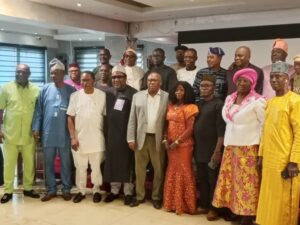
The new Executive of the League of Maritime Editors led by Pastor Felix Kumuyi
This sequencing should not be interpreted as an indication that the Eastern ports are being neglected.
Rather, it reflects the practical realities of project preparation, financing, procurement and implementation.
The Eastern ports programme is being advanced as part of the same broader national strategy, with the objective of ensuring that the interventions are properly designed, financed and implemented for sustainable results.
iv. Creating a Truly Multi-Port System
The long-term objective of the Government is not simply to improve the Lagos ports.
Our objective is to create a multi-port system in which cargo owners and shipping lines have viable alternatives and can choose gateways based on efficiency, cost, reliability and proximity to their markets.
A modernised Lagos port will reduce pressure on the system. Modernised Eastern ports will provide additional capacity and alternative gateways. The two strategies are therefore complementary.
We are not developing Lagos at the expense of the East. We are strengthening Lagos while building the capacity of the Eastern corridor to assume a greater and more strategic share of national maritime traffic.