




DCG NNADI REVIEWS THE BOOK‘ CUSTOMS OPERATIONAL REVOLUTION & DEVELOPMENT OF MARITIME INDUSTRY UNDER PRESIDENT TINUBU’
“It is a privilege and honour to review CUSTOMS OPERATIONAL REVOLUTION AND THE DEVELOPMENT OF THE MARITIME INDUSTRY UNDER PRESIDENT TINUBU, an important publication authored by Mr. Timothy Okorocha and Mr. Francis Ugwoke – two highly respected veteran maritime journalists whose professional footprints within the maritime and trade ecosystem span several decades. This work not only documents the evolution of the Nigeria Customs Service but also situates Customs within the wider architecture of Nigeria’s maritime economy, trade governance, institutional reforms, and national development.
At a time when nations increasingly recognise the importance of institutional memory, this book arrives as both a scholarly intervention and an archival contribution. Institutions that fail to document their evolution risk historical amnesia. They risk forgetting the reforms, sacrifices, leadership decisions, and operational experiences that shaped their journey. This book attempts to preserve that memory.
What immediately distinguishes CUSTOMS OPERATIONAL REVOLUTION AND THE DEVELOPMENT OF THE MARITIME INDUSTRY UNDER PRESIDENT TINUBU is its breadth of ambition. It is not merely a historical account of Customs operations. Rather, it is a carefully layered examination of how the Nigeria Customs Service evolved from a colonial revenue institution into a modern agency central to revenue mobilisation, border security, trade facilitation, and economic regulation.

The authors take readers through the historical trajectory of customs administration in Nigeria from the nineteenth century to the present era of digitisation and institutional modernisation. In doing so, the book demonstrates that Customs cannot be understood in isolation from the political and economic history of Nigeria itself.
One of the book’s strongest contributions lies in its analytical treatment of policy evolution. Rather than merely listing historical milestones, it explains how tariff systems, excise regimes, legal reforms, anti-smuggling operations, and administrative transitions influenced institutional performance. The reader is encouraged to see Customs not simply as a revenue collector, but as an instrument of state capacity, trade governance, and national economic management.
The sections dedicated to revenue generation are particularly illuminating. The author successfully traces the progression of Customs revenue from modest colonial collections to record-breaking contemporary performance, showing how institutional reforms, digital systems, enforcement mechanisms, and leadership choices influenced fiscal outcomes. The treatment of automation from ASYCUDA to NICIS and now the B’Odogwu digital platform is especially commendable because it presents technological reform not merely as digitisation, but as institutional transformation.
However, what makes this publication particularly noteworthy is that nearly a quarter of its intellectual focus extends beyond Customs into the broader maritime governance ecosystem. This is an important strength of the work because Customs does not operate in a vacuum. Trade facilitation, port efficiency, maritime security, inland waterways development, freight forwarding professionalism, and human capital formation are all interconnected within a single maritime value chain.
The book thoughtfully examines the emergence of the Federal Ministry of Marine and Blue Economy under the administration of President Bola Ahmed Tinubu and presents it as a structural effort to reposition Nigeria’s maritime future. Readers are introduced to the policy vision of the marine and blue economy as one capable of expanding national economic possibilities beyond conventional port activities into broader maritime prosper

Equally important is the treatment of the Nigerian Ports Authority (NPA), which the book correctly identifies as the backbone of Nigeria’s maritime gateway. The discussion on port rehabilitation, dredging, digital transformation, infrastructure fatigue, and deep seaport development reflects a strong appreciation of the strategic importance of efficient port administration to national competitiveness.
The book also devotes significant attention to the Nigerian Maritime Administration and Safety Agency (NIMASA), especially in relation to maritime safety, shipping regulation, anti-piracy efforts, indigenous fleet development, and seafarer training. Particularly insightful is the examination of the Cabotage Vessel Financing Fund (CVFF) and the challenge of converting Nigeria from merely a cargo-generating nation into a true maritime power with indigenous shipping capacity.
Another notable inclusion is the treatment of the Nigerian Shippers’ Council (NSC) as the economic referee of the port system. The book offers a balanced assessment of the Council’s role in tariff monitoring, dispute resolution, economic regulation, and protection of cargo interests within an increasingly commercialised port environment.
Beyond these agencies, the work extends its attention to the National Inland Waterways Authority (NIWA), the Council for the Regulation of Freight Forwarding in Nigeria (CRFFN), and the Maritime Academy of Nigeria, Oron – thereby presenting maritime administration as a collaborative ecosystem rather than a fragmented institutional landscape.
This wider maritime representation significantly enriches the book. It recognises an important reality: that the effectiveness of Customs is deeply dependent on coordination with sister agencies across the marine and trade environment. Efficient ports require functional regulators. Secure waterways require coordinated governance. Competitive trade systems require professional freight forwarding and maritime manpower development.
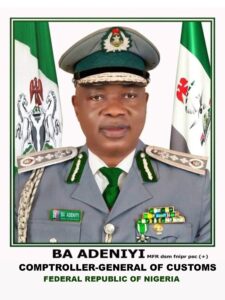
Another point of the text is the leadership of the current Comptroller-General of Customs, Dr. Bashir Adewale Adeniyi MFR, whose appointment the authors describe as both symbolic and transformative. As one who worked closely with the CGC Adeniyi rising from the Comptroller serving as Area Controller, Seme Boarder Command and Tincan Island Port Command, before working more closely with CGC Adeniyi as Assistant Comptroller-General and later Deputy Comptroller-General; I can attest to the transformative leadership captured in the book.
From a scholarly perspective, this publication demonstrates substantial research effort. It is particularly commendable that the authors, drawing from their extensive experience as veteran maritime journalists, have combined institutional history with sectoral insight in a way that makes the book both informative and accessible to professionals and general readers alike. The integration of historical records, policy analysis, institutional perspectives, performance evaluation, and sectoral commentary makes the work useful not only to Customs officers and maritime stakeholders but also to scholars of governance, political economy, maritime studies, public administration, international trade, and security.
Expectedly, a work of this scale may still benefit from future expansion. Subsequent editions could include broader comparative analysis with customs and maritime administrations in other jurisdictions, deeper statistical illustrations, and additional case studies to strengthen empirical engagement. Such observations, however, should be viewed not as criticisms but as opportunities for further development.
Ladies and gentlemen, good books preserve knowledge. Important books preserve institutional memory. But truly significant books provoke reflection, shape conversations, and challenge institutions to think strategically about the future.
CUSTOMS OPERATIONAL REVOLUTION AND THE DEVELOPMENT OF THE MARITIME INDUSTRY UNDER PRESIDENT TINUBU achieves much of that.
For younger officers of the Nigeria Customs Service, it offers lessons in institutional identity and professional evolution. For maritime agencies, it reinforces the importance of collaboration in achieving trade efficiency and economic growth. For policymakers, it highlights the relationship between customs administration, maritime governance, and national competitiveness. For scholars, it opens pathways for further inquiry into one of Nigeria’s most strategically important sectors.
It is therefore my considered view that this book represents a meaningful and commendable contribution to the literature on customs administration, maritime governance, and institutional development in Nigeria. It deserves recognition for its scope, relevance, historical depth, and effort at documenting the evolving relationship between Customs and the broader maritime ecosystem.
Permit me to specially congratulate the authors – Mr. Timothy Okorocha and Mr. Francis Ugwoke, both distinguished veteran maritime journalists – for this commendable intellectual effort and for contributing meaningfully to the preservation of the institutional memory of both the Nigeria Customs Service and the wider maritime sector. Their years of professional engagement within Nigeria’s maritime and trade environment undoubtedly lend credibility, depth, context, and practical insight to this publication.
I encourage all stakeholders present today not merely to acquire this book, but to read it thoughtfully, engage with its ideas, and reflect deeply on its implications for the future of customs administration, maritime governance, trade facilitation, and national development in Nigeria.
On this note, distinguished ladies and gentlemen, I am pleased to wholeheartedly commend this book to officers of the Nigeria Customs Service, maritime professionals, policymakers, scholars, researchers, and all stakeholders invested in the future of Nigeria’s trade and maritime economy.
Thank you, and God bless the Federal Republic of Nigeria.”