



CUSTOMS, MAN IN HOURS OF CONSULTATIVE DIALOGUE, REACH ACCORD TO REFLATE THE NATION’S ECONOMY
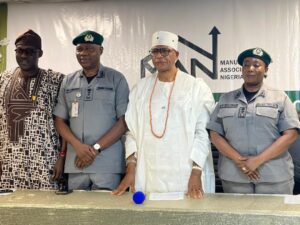
The Nigeria Customs Service (NCS) and the Manufacturers Association of Nigeria (MAN) held a productive strategic engagement today to strengthen collaboration in support of Nigeria’s industrial growth and economic development objectives. This meeting was
convened following the Ministry of Finance’s directive regarding the temporary suspension of the 4% FOB charge, which provided an opportunity for comprehensive
stakeholder consultation as required under the Nigeria Customs Service Act 2023. Apart
from this, the consultative dialogue provided us an opportunity to review and discuss
issues around the operating environment for manufacturing irn Nigeria. The exchanges
were open, frank and cordial.
Both organizations remain committed to Nigeria’s economic transformation through
enhanced manufacturing sector performance. The engagement highlighted the need for clear alignment between customs trade facilitation objectives and manufacturing sector development needs, with extensive discussions revealing mu tiple areas of mutual interest and support mechanisms available to boost manufacturing operations for the overall
benefit of the Nigerian economy.

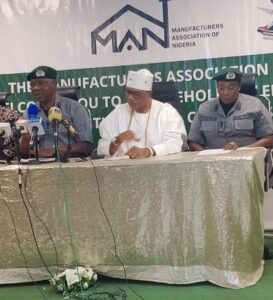
The Manufacturers Association of Nigeria provided valuable insights into operational
challenges faced by the manufacturing sector and identified specific areas where
enhanced collaboration could improve industrial competitiveness. The issues include:
a. The implementation of the 4% FOB as funding for NCS Operations.
b. Multiple checkpoints as threat to trade facilitation.
c. Multiple alerts in the clearance system.
d. The B’Odogwu platform glitches.
On its part, the Nigeria Customs briefed MAN on the various Trade Facilitation
Initiatives undertaken by the Service. This includes the Economic Operator Programme
(AEO), Advance Ruling, and Time Release Study. NCS, during the dialogue expressed
strong commitment to balancing its revenue generation mandate with innovative trade
facilitation measures.


Flowing from the discussions which followed the presentations, the following were concrete outcomes of the interaction.
a. Nigeria Customs Service announced that following consultations with the Honourable
Minister of F Finance and the Coordinating Minister of the Economy, approval has been granted for strategic exemptions from the 4% FOB charges on the following, among others:
*Importation of raw materials, spares, and machines ty the manufacturers who are
beneficiaries of concessions contained in Chapters 98 anc 99 of the Customs Tariff, Manufacturers who are currently on chapters 98 anc 99 are advised to apply for pre-release of the consignment to avoid payment of demurrage.
In addition,
*Members of MAN Who import raw materials, machines, and spares that are not currently on chapters 98 and 99 to be onboarded in order to enjoy the exemptions
provided in 5(i) above.
*MAN, NCS, and the Federal Ministry of Finance will work together for the inclusion of manufacturers that are currently not on chapters 98 and 99.
*An immediate tripartite consultation of the Federal Ministry of Finance, NCS, and
MAN Would be held immediately to work out the modalities for expedited onboarding of manufacturers on chapters 98 and 99.
*In the meantime, the 4% FOB payments already made by manufacturers who are
yet to be onboarded to chapters 98 and 99 will be held as credit and be utilized for future customs-related transactions after their onboarding.
*Government projects with Import Duty *Exemptions Certificates.
*Goods imported for Humanitarian, Life Saving and other related purposes.
*Beneficiaries of the Presidential Initiative for unlocking Healthcare value chain. *Commercial airlines’ spare parts.


Manufacturers Association of Nigeria commends the AEO scheme; hence, it was agreed that a clear guideline for admission would be issued by the Nigeria Customs Service.
The gesture of these exemptions presents Concrete evidence of the Service’s
commitment to supporting critical sectors of the economy as it continues to maintain
appropriate revenue collection frameworks.
Beyond existing exemptions, discussions focused on additional trade facilitation
initiatives being implemented by the Nigeria Customs Service to support manufacturing
operations.


These include the development of one-stop shop frameworks designed to
streamline regulatory processes and eliminate bureaucratic bottlenecks, systematic reduction of unnecessary checkpoints that add costs without corresponding value, and integration of digital solutions to accelerate legitimate trade processing as well as maintain security standards. The Service also outlined technology-driven initiatives aimed at providing real-time clearance capabilities and automated risk assessment systems that reduce compliance costs for legitimate operators.
Both organizations agreed to establish formal consultation mechanisms ensuring
regular dialogue on policy developments affecting manufacturing operations, including proactive engagement on customs policy changes before: implementation, feedback systems allowing real-time assessment of policy impacts, and periodic review meetings to assess progress and identify new collaboration opportunities.

The engagement emphasized economic impact considerations, with both
organizations committed to supporting Nigeria’s economic diversification objectives
through job creation, export promotion, foreign exchange conservation through import substitution, and development of industrial clusters supported by predictable customs environments. Technology partnerships were also identified as critical enablers.
Moving forward, the Nigeria Customs Service commits to maintaining ongoing
consultation with manufacturing sector stakeholders, continuing development of trade facilitation infrastructure supporting industrial growth, implementing technology solutions that reduce compliance costs, and providing regular briefings on policy developments.

The Manufacturers Association of Nigeria commits to constructive engagement in policy dialogue processes, providing sector-specific expertise to inform customs policy
development, supporting member compliance with regulations, and collaborating developing industry best practices.
This engagement highlights a strengthened partnership between two critical institutions supporting Nigeria’s economic development. The outcomes achieved is evident that constructive dialogue produces superior results fcr all stakeholders and is essential in maintaining the highest standards of regulatory compliance and economic governance. Both organizations look forward to implementing the agreements reached and continuing to build a customs environment that supports manufacturing excellence and meeting national revenue and security objectives.