

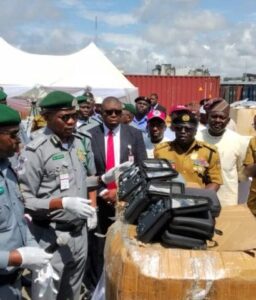


APAPA CUSTOMS LEADING IN REVENUE, BRUTAL IN ENFORCEMENT; INTERCEPTS N43.5 BILLION HARD DRUGS, DRONES & EXPIRED PHARMACEUTICALS
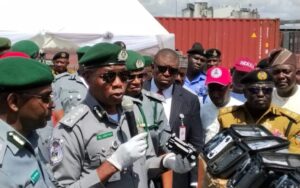
CGC Adewale Adeniyi briefing the Press at Apapa CGC Adewale Adeniyi briefing the Press at Apapa
By Timothy Paul Okorocha
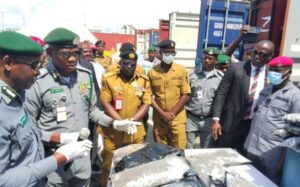
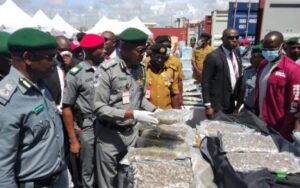
Hard drugs, drones and other contraband worth more than N43.5 billion have been intercepted by the officers of the premier command, Apapa. 7.6 tonnes of cannabis sativa, as well as 169,998 bottles of codeine based syrup are among the seizures.
Briefing newsmen in Apapa today, the Comptroller General, Bashir Adewale Adeniyi, PhD, MFR, said 1,282 bales of used clothing, including five containers of expired consumer and pharmaceutical products were also seized.
While handing over the drugs and other seizures to officials of the NDLEA, and the NAFDAC, he disclosed that the operation was intelligence-driven, after a comprehensive cargo profiling, documentary scrutiny, targeted examination and collaboration amongst relevant security and regulatory agencies.
He noted that the development was a product of the agency’s shift from routine inspections to intelligence-led targeting of high risk consignments, in line with the broader mandate under the Nigeria Customs service Act of 2023.
According to him, criminal networks are increasingly exploiting legitimate trade channels to conceal prohibited goods in ordinary-looking consignments.
“Concealment is now built into otherwise legitimate consignments,” Adeniyi said, explaining that narcotics could be concealed among vehicle spare parts and used vehicles, while controlled drugs and restricted equipment could be hidden beneath household goods or declared as ordinary electronics.
The CGC said the Service had strengthened its cargo profiling and risk-assessment capabilities, including the deployment of the B’Odogwu platform to improve the analysis of trade data and identification of suspicious shipments.
He also disclosed that an INTERPOL Data Centre was established at the Customs headquarters in Abuja in July, giving officers access to more than 152 international databases.
Adeniyi said cooperation with the National Drug Law Enforcement Agency (NDLEA), NAFDAC, the Office of the National Security Adviser and international security partners had further enhanced the Service’s capacity to detect and disrupt sophisticated smuggling networks.
Three containers intercepted by the command contained a combined 15,245 parcels of cannabis sativa weighing 7,624kg. The first container, HAMU 3086682, contained 4,777 parcels weighing 2,388.5kg, concealed alongside automobile spare parts, coffee mix, oats and three vehicles.
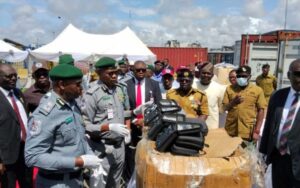
Another container, FANU 1933352, contained 8,287 parcels weighing 4,145kg, also concealed alongside three vehicles. The third container, MSKU 3941778, contained 2,181 parcels weighing 1,090.5kg, hidden among other goods, including foreign parboiled rice, automobile spare parts, lithium batteries, turmeric and fish products.
Adeniyi attributed the interception of the cannabis consignments to intelligence-sharing and operational cooperation between Customs, the NDLEA and international security partners. Customs officers also intercepted a 40-foot container, TCKU7653306, containing 1,700 cartons of codeine syrup comprising 169,998 bottles. The controlled pharmaceutical products were concealed beneath household items.
Adeniyi warned that the abuse of prohibited substances such as codeine remained a serious threat to society, with consequences including violent conduct, family breakdown and the loss of productive lives. He said Customs would continue to prevent Nigerian ports from being used as entry points for dangerous controlled substances. The command further intercepted 108 high-definition dual-camera drones from container MSKU 9282528.
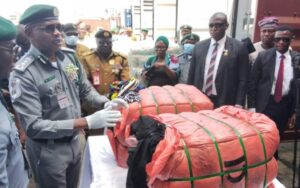
While acknowledging the legitimate applications of drones, Adeniyi warned that the equipment could pose a security threat if acquired by criminal elements, particularly for surveillance, reconnaissance and delivery operations.
He urged importers of restricted or security-sensitive equipment to obtain the required security approvals, end-user certificates and other documentation before shipment. “Consignments of that character that arrive without them will be detained,” he warned.
The CGC said the ports would not be allowed to become channels through which security-sensitive capabilities reached persons or groups working against the country.
The operation also led to the interception of five containers carrying expired products, including tomato ketchup, antiseptic liquid, vaginal tablets and disposable nappies. The affected containers were identified as SUDU 7593139, PCIU 2834954, ZCSU 8749546, PONU 7890827 and MSKU 1524590.
Adeniyi described the importation of expired products as particularly disturbing because the consignments were intended for household consumption and personal use. He warned that such products could expose consumers, including children and women, to serious health risks.
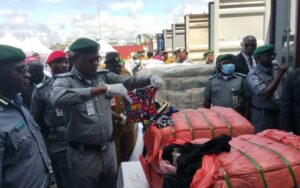
The Command also seized 1,282 bales of used clothing from three 40-foot containers. The bales comprised 425 from MRKU 6185100, 435 from MRKU 5535966 and 422 from SEKU 4685299.
Meanwhile, Adeniyi assured legitimate importers and traders that the enforcement drive was not aimed at frustrating lawful commerce. He said the Service would continue to facilitate the efficient movement of legitimate cargo while directing greater scrutiny towards consignments, transactions and operators identified as presenting risks.
The CGC advised importers who were uncertain about the classification, valuation or origin of their goods to use the Advance Ruling mechanism before shipment. He also encouraged compliant businesses to enrol in the Authorised Economic Operator (AEO) programme, which provides more predictable clearance and fewer interventions where risk assessments support such treatment.

Adeniyi said compliance should be viewed as a business advantage rather than an obstacle. He commended officers and men of the Apapa Area Command for their vigilance and professionalism, as well as the NDLEA, NAFDAC and international security partners for their contributions to the operation.
He added that the seized narcotics and other controlled items would be handed over to the appropriate agencies for further action in line with established procedures.
The CGC reaffirmed the determination of the Customs Service to keep Nigeria’s ports focused on legitimate commerce, industrial development and economic prosperity, rather than allowing them to serve as channels for narcotics, dangerous pharmaceuticals, security-sensitive equipment and other prohibited goods.