
 NIMASA CORPORATE STRIP

CGC, POWER MINISTER TOUR APAPA PORT, KICKSTART RELEASE OF 300 CONTAINERS OF TRAPPED ELECTRICITY EQUIPMENT TO IMPROVE POWER SUPPLY
By Timothy Paul Okorocha
Succour may have come the way of Nigerians towards solving the intractable electricity puzzle which the country has found itself in the last 30 years.
This followed the start of the release of more than 300 containers of electricity equipment which were imported by the federal government through fraudulent contractors who abandoned them at the seaports for decades now.
Power minister and the Customs Comptroller General were united in trumping the logic by President Tinubu in deciding to release those equipment now, even when some people suspect that the timing was political. At a start, 98 containers are to be released immediately from the Apapa sea port.
Tinubu’s power minister was at a loss on whether the equipment will write off the power deficit currently bedeviling the nation. He could not also give a definite timeline when power will improve, following the government action.
As he was addressing the stakeholders and the media, his efficiency was also called to question, following power outage on the spot, necessitating guests to shout ‘up NEPA’ for him.
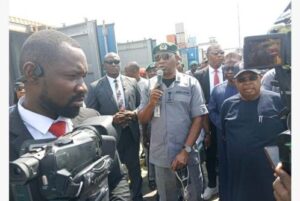
While briefing the media on the clearance of the stranded power sector equipment at the nation’s seaports, the Customs Comptroller General, Bashir Adewale Adeniyi, MFR, PhD said;
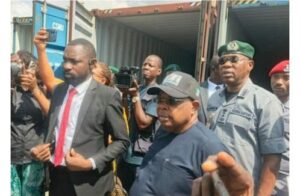
“Reliable electricity is central to the Renewed Hope Agenda of President Bola Ahmed Tinubu, GCFR. Since 2023, the administration has taken bold steps to reposition the power sector for growth, investment and dependable supply. The Electricity Act 2023 opened the electricity market to states, allowing them to generate, transmit and distribute power. The Presidential Power Initiative with Siemens Energy has been revived to expand transmission capacity across the country. Government has also moved to settle verified legacy debts in the sector, close the metering gap and extend off-grid power to underserved communities, universities, markets and hospitals. The direction is clear: generate more power, move it efficiently through the grid and deliver it to homes, businesses and industries. Every agency of government has a part to play in achieving that goal.”
“Over the years, equipment imported for critical power projects remained uncleared at our ports, in some cases for between 14 and 20 years. These consignments include high-capacity transformers, cables, switchgear and other transmission equipment imported through the Federal Ministry of Power and the Transmission Company of Nigeria. Following a presentation by the Honourable Minister of Power at the Federal Executive Council, Mr President directed the immediate clearance of the equipment. He also directed the relevant agencies to resolve all outstanding charges and administrative bottlenecks without delay.”
“In line with that directive, the Service has commenced the clearance of more than 300 containers of power equipment. Today, I am here at the Apapa Port with the Honourable Minister of Power to flag off the release of the first 44 containers. Another 54 containers at other terminals will be released in turn. We are working closely with the Federal Ministry of Power, the Transmission Company of Nigeria and the Nigerian Ports Authority to complete the exercise as quickly as possible. We have deployed every facilitation measure within our mandate, including priority processing of the consignments, dedicated officers for joint examination, and the application of approved waivers on charges that accrued while the goods remained uncleared.”
“After release, technical experts will inspect the equipment. Serviceable items will be deployed to ongoing and stalled projects, including transmission corridors and substations across the country, and obsolete items will be disposed of in accordance with extant regulations.”
“This progress would not have been possible without the support of our partners in government. I commend the Honourable Minister of Finance and Coordinating Minister of the Economy, Mr Taiwo Oyedele, for approving the waivers on the accumulated charges on these consignments. I also thank the Honourable Minister of Marine and Blue Economy, Mr Adegboyega Oyetola, CON, for approving the waiver of demurrage charges. Together, these approvals removed the cost barriers that had kept vital national assets locked in our ports for far too long.”
“This exercise has also exposed a troubling pattern. Some contractors awarded government projects import equipment, abandon it at the port and fail to execute the projects for which public funds were committed. The power sector has not been spared. Such conduct denies Nigerians the electricity, jobs and services those projects were meant to deliver. Contractors who accept government projects and fail to deliver, while abandoning project materials at the ports, should be regarded as economic saboteurs. The Service will work with supervising ministries and the relevant oversight agencies to identify government consignments that remain uncleared. We will make that information available so that defaulting contractors can be held to account.”
“The Nigeria Customs Service remains fully committed to the Federal Government’s drive to revive the power sector and complete stalled projects. We urge all ministries, departments and agencies with consignments at the ports to engage with the Service promptly, so that no project critical to national development is held back at the border.”
In his address, the power minister, Joseph Tegbe said; “for up to twenty years, over 300 containers of transmission equipment have remained stranded at the Nigerian ports. These consignments were acquired for projects intended to expand the network, relieve overloaded substations and improve our capacity to deliver electricity across the country.”
“The consequences have been considerable. First, essential equipment remained unavailable while projects awaiting those materials suffered delays.
Secondly, existing substations continued to carry loads that new facilities were intended to share, increasing pressure on ageing assets and limiting operational flexibility. Thirdly, prolonged storage exposed valuable equipment to deterioration.”
“Recognising these consequences, we intensified efforts to secure the release of the containers. Our engagement has focused on bringing the relevant institutions together, addressing outstanding clearance requirements and finding a practical resolution to the accumulated charges. The guiding consideration throughout this process has been the interest of the Nigerian people and the urgent need to recover these assets for productive use and deliver reliable electricity access to Nigerians.”
“I am particularly grateful to His Excellency, President Bola Ahmed Tinubu, GCFR, who approved the release of the containers and directed the necessary collaboration to facilitate their clearance. His intervention demonstrates his readiness to take decisions that advance the power sector and serve Nigeria’s wider economic interests.”
“Today, I am pleased to announce that the Nigeria Customs Service has approved the release of 98 of the over 300 containers. This is a significant first step. Our immediate task is to translate that approval into physical evacuation, while
sustaining efforts to secure the release of the remaining consignments.”
“I want to specially commend and express our appreciation to the Comptroller-General, CG Bashir Adewale Adeniyi, and officers of the Nigeria Customs Service for their cooperation. Your support has been exceptional, and Mr President recognises your collaboration in ensuring this administration delivers reliable electricity service to every Nigerian. I also acknowledge the Federal Ministry of Finance, especially the Honourable Minister of Finance, Taiwo Oyedele, and the Honourable Minister of Marine and Blue Economy; the Nigerian Ports Authority; the relevant terminal operators and shipping companies, including ENL, APMT, Maersk and TCMP; and the management and technical teams of the Transmission Company of Nigeria. I thank the officials of the Federal Ministry of Power whose sustained engagement has helped advance this process. Their collective contribution deserves recognition.”
“Following evacuation, our engineers will verify the inventory, assess the condition of the equipment and undertake the necessary tests. Where refurbishment is required, we will undertake it prior to deployment. Serviceable materials will be
matched to their intended projects and current network requirements, with priority given to completing stalled installations, relieving overloaded substations and strengthening constrained transmission corridors.”
“As those projects enter service, they will add usable capacity at the affected locations, improve the evacuation of available generation and provide greater flexibility for maintenance and fault management. The precise additional capacity will be established from the verified equipment ratings and completed project configurations and communicated accordingly.”
“Ladies and Gentlemen, you would recall that we made four promises at inception. These are: a disciplined approach to solving the sector’s problems, pursuing grid stability through structured, strategic reforms; visible incremental improvements; and honest communication with Nigerians. While improvements remain modest, we want to assure you that we are firing on all cylinders to ensure that we overcome the binding constraints. The deployment of the equipment in these 98 containers will help us move closer to our target.”
Furthermore, the expected gains from the deployment of this equipment are practical. It will ensure fewer interruptions associated with overloading, improved voltage performance and a stronger network through which electricity can reach homes, businesses and essential services. These improvements will support the wider work underway across generation, transmission and distribution to deliver more dependable supply.”
“Ladies and Gentlemen, we will deploy the best-in-class project management approach to follow this recovery through to installation and commissioning, and provide updates on the remaining containers. We are also strengthening coordination around future equipment deliveries so that procurement, clearance, transportation and site readiness receive attention together.
“With the immense support that we have received from His Excellency, President Bola Ahmed Tinubu, GCFR, and ongoing strong inter-agency collaboration with the Nigeria Customs Service, we believe that we will secure the release of the remaining consignments without further delay. Our commitment is to a power sector that serves Nigerians better, supports enterprise and gives greater substance to the promise of renewed hope.”